Marine Parade
The Death of Bunny MunroMarine Parade is the seafront setting for a small but consequential departure: while Bunny leaves him in the Punto, Bunny Junior steps out to buy food and becomes caught up in the belief that his mother is nearby. The promenade’s road, crossing, food booth, stairs, and outdoor café organize the episode as a passage between waiting and pursuit. For the boy, the place is at once an ordinary public thoroughfare and a landscape made difficult to read by hunger, fear, and his increasingly uncertain sight.
The seafront and the parked car
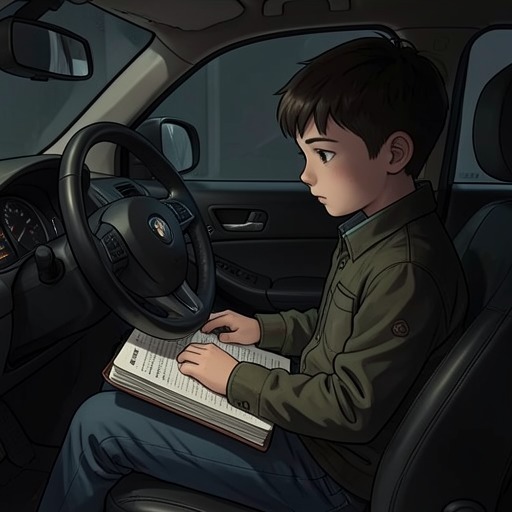
The Punto is parked on Marine Parade, where Bunny Junior rests his head against its window and watches people pass. He wonders what he is meant to be doing and whether learning the Patience Law is all his father intends to teach him about selling. His uncertainty is practical as well as emotional: he has been left waiting, and he does not know when Bunny will return or when he will be shown how to make a sale.
The boy’s thoughts turn toward his worsening blepharitis and the possibility that he is becoming confused. In The Encyclopaedia, he has looked up both mirage and apparition, but their definitions do not help him understand what he experiences. He has come to believe that his mother is searching for him and has something important to say. Staying on Marine Parade therefore takes on an apparent purpose: if he waits long enough, he thinks, she may find him. He also believes he has something to tell her, though hunger prevents him from recovering what it is.
That hunger steadily competes with his decision to remain in the car. He remembers the Cornish pasty he did not eat at lunchtime, sees young people passing with chips, and notices a fish-and-chip booth across the road. The smell of the food sharpens the need he has been trying to endure. He knows he is not supposed to leave, but imagines his father returning to find him dead from hunger and wonders what that would mean for the Patience Law. After counting to one hundred and checking both directions, he opens the car door with three one-pound coins in his pocket.
From waiting to pursuit
Bunny Junior estimates that the booth is only a short walk away: down to the pedestrian crossing and across the road. Even this small distance becomes an ordeal. Panic rises as he starts out, and he feels his heart pounding. Marine Parade changes from a place where he can sit and wait for his mother into a route he must cross alone, with his father’s prohibition still in mind and the promise of food drawing him forward.
At the booth, he asks for vinegar, pays for the chips, and turns to see a woman he takes to be his mother walking away down the promenade. She is wearing an orange dress, with her blonde hair tied back. A man standing beside him speaks about reporting him to the authorities. Bunny Junior recoils, fearing that the man intends to eat him, then watches the apparent sight of his mother disappear into the crowd and runs after her.
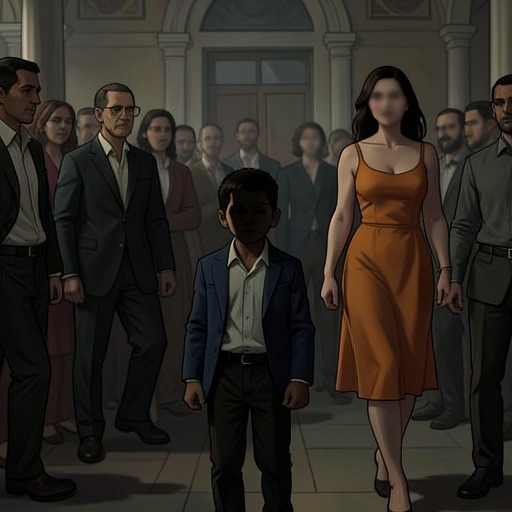
The passing crowd becomes difficult for him to interpret: people seem unnaturally large and their faces mask-like. He cannot find the woman, stops on the promenade, and eats some of the chips. Looking down from the wrought-iron railing toward the lower promenade, he sees what he takes to be his mother talking with people at an outdoor café. She is smoking, a change that surprises him; he thinks he will tell her to put out the cigarette when he catches up. He descends the stairs toward her, still carrying the paper cone of chips. The setting’s distinct levels—the main promenade above and the café below—give his search a succession of brief apparent discoveries and losses.
Return to the Punto
Bunny Junior eventually makes his way back up the steps and along the promenade, past the food booth and across the crossing to the Punto. Returning to the car brings palpable relief: after moving through a crowd he has experienced as threatening and pursuing the mother he could not keep in sight, the familiar passenger seat feels like a place where he belongs. He locks the door, rests his head against the window, and recalls episodes of his mother’s distress at home, including her crying on the kitchen floor and throwing Bunny’s shirts around the bedroom. The memory complicates his longing; the mother he seeks is also someone he remembers as unwell, though he associates her with softness and a pleasant smell.
The return does not resolve the uncertainty of the episode. A sudden knock on the window frightens him, and he covers his eyes, pleading not to be eaten. Marine Parade has taken him only a short distance from the car, but the errand has become a disorienting search shaped by hunger, fear, and his belief that his mother is looking for him. The boy’s departure is neither an act of simple disobedience nor a successful reunion: it ends with him back where he started, carrying the experience of having seen and lost her again.
Bunny and the police officer
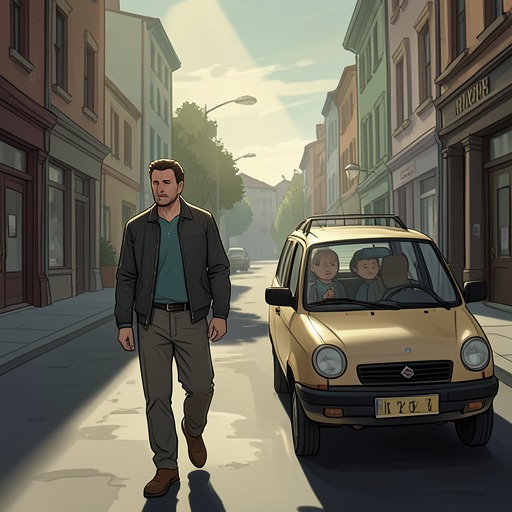
Marine Parade also frames Bunny’s return to the Punto after his visit to Mrs Brooks. Outside her home, he pauses in the afternoon light and sea breeze, aware of the atmosphere of the house he has just left. Walking down to Marine Parade, he sees a female police officer standing beside the car and speaking into a radio transmitter. He approaches and asks whether he can help her, while wondering why she is there.
The juxtaposition links Bunny’s separate encounter with the officer to the place where Bunny Junior had earlier been left waiting and from which he had ventured out alone. The parked car is a fixed point in both episodes, but its meaning shifts: for the boy it is the refuge he returns to after a frightening search; for Bunny it is the place beside which an officer’s presence raises an unexplained question. Marine Parade thus holds together the father’s and son’s separate movements without making their experiences interchangeable. Its public paths and crossing permit brief departures, while the car remains the point to which the boy returns and beside which the next interruption begins.